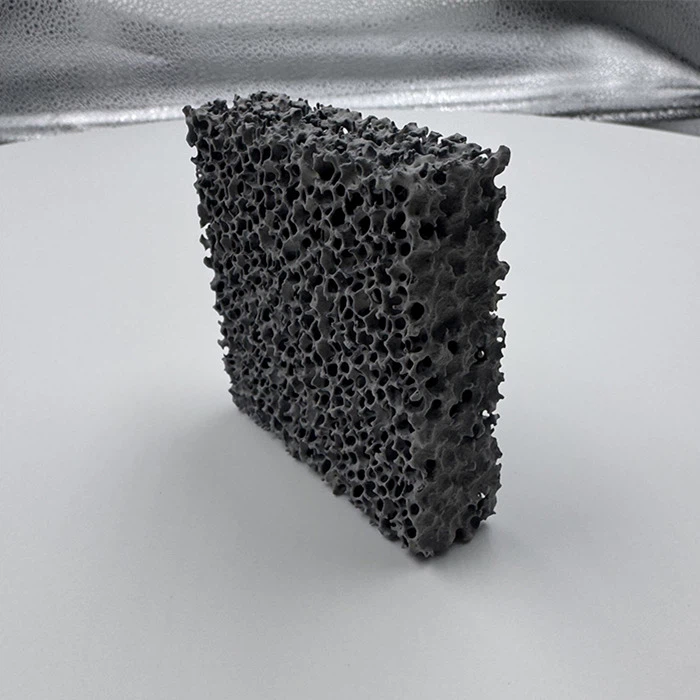
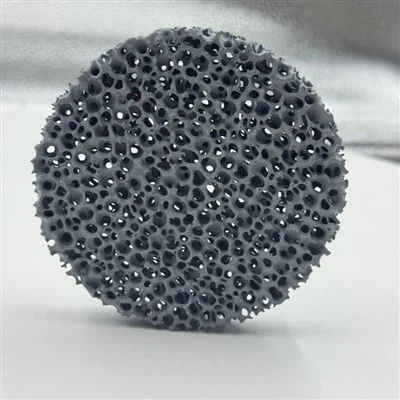
Silicon Carbide Ceramic Foam Filter

Product Overview


Silicon Carbide (SiC) Ceramic Foam Filters are engineered for filtration and flow conditioning of molten ductile iron, gray iron, and copper alloys. Featuring a 3D interconnected open-cell framework, these filters capture non-metallic inclusions, slag, and dross via depth-filtration mechanics while converting turbulent gating streams into uniform laminar flow.


Material & Construction


Matrix Composition:

High-purity Silicon Carbide (SiC) combined with a stable silicate-ceramic bond phase.


Microstructure:

Reticulated open-cell foam geometry providing high specific surface area for inclusion adsorption.


Refractoriness:

Maximum operating temperature threshold up to 1500°C.


Porosity Structure:

Controlled apparent open porosity of 80% to 90% to ensure unobstructed metal throughput.


Filtration Characteristics


01

Mechanisms:

Combines cake filtration (surface trapping of macro-slag) and depth filtration (adsorption of micro-particles onto ceramic struts via surface tension and tortuous path dynamics).

02

Hydraulic Control:

Suppresses metal velocity and turbulence in the runner system, minimizing aspiration, sand mold erosion, and re-oxidation.

03

Thermal Shock Resistance:

Withstands rapid thermal gradients without structural spalling upon direct contact with iron melts at 1350°C to 1450°C.

Silicon Ceramic Foam Filter


Applications
 

Ductile Iron (SG Iron):

Wind turbine components, automotive brake discs, crankshafts, and hydraulic housings.

Gray Iron:

Engine blocks, cylinder heads, and industrial machine beds.

Non-Ferrous Alloys:

Heavy bronze, brass, and copper alloy castings.

Placement Position:

Inserted horizontally inside the gating system (runner, parting line, or directly under the downsprue base print).


Technical Specifications


Property

Typical Value

Test Reference / Condition

Primary Phase

SiC matrix (50% - 90% dependent on grade)

ICP-AES elemental analysis

Max Working Temp

<= 1500°C

Pyrometric Cone Equivalent

Bulk Density

0.36 - 0.50 g/cm3

ASTM C20

Cold Compressive Strength

>= 0.9 - 1.2 MPa (Parallel to axis)

ASTM C133 (Room Temp)

Porosity

80% - 90%

Archimedes Method

Thermal Shock Stability

>= 6 cycles (1100°C to air quench)

Internal Quench Protocol

Standard Dimensions

Square/Rectangular: 50x50 to 150x150 mm

Round: Dia 40 to Dia 150 mm

Thickness: 15, 22, 25 mm


Filter Selection Guide


Pore Density (PPI) Selection:
10 PPI: Applied for heavy section gray/ductile iron castings (> 500 kg) requiring high volume throughput and fast pouring rates.


20 PPI: Standard baseline specification for automotive and general industrial iron castings (50 kg to 500 kg).


30 PPI: Selected for thin-walled, pressure-tight components requiring strict micro-inclusion control.

Sizing & Flow Calculation:
Filter cross-sectional area must maintain a ratio of 1.5x to 2.0x relative to the gating system choke area to avoid flow restriction.


Peripheral ceramic fiber sealing gaskets must be utilized to eliminate liquid metal bypass.


Manufacturing & Quality Control
01.

Production Route:

Polyurethane foam impregnation, controlled slurry rheology coating, drying, and controlled-atmosphere high-temperature sintering.

02.

Dimensional Sorting:

100% size verification for length, width, and thickness tolerances (+/- 1.0 mm).

03.

Mechanical Testing:

Lot-based destructive cold compressive strength testing and visual sweep for blocked cells, warping, or structural cracks.

04.

Traceability:

Each production lot is marked with a batch tracking code corresponding to raw material assay records.


Customization & OEM

Custom Profiles:

Geometric fabrication in round, rectangular, square, or stepped configurations to fit existing foundry pattern equipment.

Edge Sealing Options:

Factory-applied or loose ceramic fiber gaskets to secure the filter inside the mold print without crushing during box closure.


FAQ


Q: How do I prevent the filter from breaking or washing out during the initial metal drop?

A: Seat the filter inside a dedicated mold print with a continuous bearing ledge of 5 mm to 10 mm on all sides. Using a pre-installed ceramic fiber gasket absorbs mold clamping loads. Furthermore, keep the downsprue static liquid head within limits so the initial metal impact pressure does not exceed the cold compressive strength (>= 0.9 MPa).

Q: What is the operational difference between 10 PPI, 20 PPI, and 30 PPI filters?

A: PPI (Pores Per Inch) defines cell count. 10 PPI provides lower flow resistance for fast pouring of heavy castings; 20 PPI balances flow dynamics and slag capture for general iron work; 30 PPI offers tighter micro-filtration at the expense of flow rate, necessitating a larger filter surface footprint.

Q: Can Silicon Carbide filters be used for carbon steel or alloy steel castings?

A: No. At temperatures exceeding 1500°C, unprotected Silicon Carbide reacts chemically with unkilled steel or high-manganese steel melts, causing carbon pickup and structural degradation. Zirconia (ZrO2) ceramic foam filters are mandatory for steel applications.

Q: How do I calculate the correct filter dimensions for a specific iron casting weight?

A: For standard ductile iron pouring conditions, a 22 mm thick SiC filter handles approximately 1.0 to 1.5 kg of iron per square centimeter of surface area. Divide your total poured liquid weight by this flow capacity factor to compute the minimum required filter surface area.

Q: Do these filters release gas or cause chemical reactions in iron melts?

A: No. Complete binder burnout during high-temperature sintering yields a chemically stable, inert SiC-ceramic matrix. They do not generate gas evolution or alter carbon/silicon balances in gray or ductile iron.

Q: What technical documentation accompanies a commercial shipment?

A: Shipments include a batch-specific Certificate of Analysis (COA) verifying bulk density, open porosity percentage, cold compressive strength, and material purity data, along with standard compliance documentation upon request.

As one of the most professional silicon carbide ceramic foam filter manufacturers and suppliers in China, we're featured by quality products and good service. Please feel free to buy high-grade silicon carbide ceramic foam filter made in China here from our factory. Contact us for more details.

improve molten metal quality, runner system filter, High Temperature Ceramic Filter

(0/10)

clearall