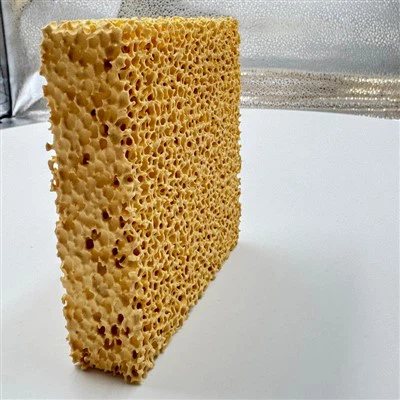
Zirconia Ceramic Foam Filter

Product Overview


Zirconia Ceramic Foam Filters are high-efficiency refractory components designed to remove non-metallic inclusions, slag, and dross from molten steel and high-alloy melts. Built on an open-cell porous ceramic skeleton, these filters transition molten metal from turbulent flow to laminar flow, eliminating re-oxidation and surface defects in critical castings.


Engineered for extreme operational environments, they maintain structural integrity at temperatures up to 1700 degrees Celsius, making them the standard choice for steel foundries producing safety-critical components.


First 12 Last 1/2

 
Material & Construction


Chemical Composition:

Stabilized Zirconia (ZrO2 + Y2O3) matrix, minimizing phase transformation cracking during rapid thermal cycling.


Porosity:

80 percent to 85 percent open porosity, ensuring unhindered metal throughput while maximizing surface-area contact for inclusion capture.


Microstructure:

3D interconnected network of dodecahedral cells that trap inclusions via cake filtration, depth filtration, and direct impaction.


Binder System:

Inorganic high-temperature refractory binders sintered at greater than 1650 degrees Celsius, eliminating volatile organic off-gassing upon initial metal contact.


Filtration Characteristics


Inclusion Removal Efficiency:

Removes particles down to 100 micrometers (depending on PPI selection), including alumina clusters, refractory fragments, and exogenous slag.

01

Flow Dynamics:

Straightens turbulent gating streams, reducing mold erosion, gas entrapment, and shrinkage cavity formation.

02

Thermal Shock Stability:

Withstands flash heating up to 1700 degrees Celsius without spalling, cracking, or generating secondary inclusions.

03

Chemical Inertness:

Non-reactive with molten carbon steel, stainless steel, and nickel-based superalloys, preventing alloy contamination.

04


Applications


01
 

Alloy Compatibility:

Carbon steel, alloy steel, stainless steel, tool steel, and nickel/cobalt-based superalloys.

 
02
 

Casting Methods:

Investment casting (lost wax), sand casting, low-pressure casting, and centrifugal casting.

 
03
 

End-Use Sectors:

Automotive powertrain components, valve bodies for oil and gas, turbine blades, railway castings, and structural aerospace hardware.

Zirconia Foam Filter


Technical Specifications


Property

Standard Value

Test Method

Main Crystalline Phase

Stabilized Zirconia (ZrO2)

XRD Analysis

Max. Operating Temp.

1700 degrees Celsius

Pyrometric Cone Equivalent

Cold Crushing Strength

greater than or equal to 0.8 MPa (at room temp.)

ASTM C133

Porosity

80 percent to 85 percent

Archimedes Principle

Bulk Density

2.6 to 2.8 g/cm3

Geometric Measurement

Thermal Shock Resistance

greater than or equal to 5 cycles (1000 degrees Celsius to room temp. water quench)

Internal Thermal Cycling Test


Zirconia Ceramic Filter


PPI (Pores Per Inch) Selection:

10 to 20 PPI: Recommended for large steel castings (greater than 500 kg) and high pouring speeds where flow volume is critical.


20 to 30 PPI: Standard for general steel and stainless steel investment castings, balancing flow and filtration efficiency.


30 to 50 PPI: Utilized for high-purity alloy steels and thin-walled components requiring micro-inclusion removal.


Sizing Rule of Thumb: Filter surface area must match or exceed the cross-sectional area of the choke section in the gating system to prevent premature choking. Ensure a minimum static metal head of 100 mm above the filter.


Manufacturing & Quality Control
01.

Production Process:

Polyurethane foam impregnation, controlled slurry rheology control, drying, and high-temperature shuttle kiln sintering.

02.

Dimensional Inspection:

100 percent manual and optical size verification for length, thickness, and squareness tolerance (plus or minus 1.5 mm).

03.

Strength Testing:

Lot-based destructive cold crushing strength (CCS) testing using hydraulic compression testers.

04.

Visual Sorting:

Elimination of blocked pores, broken edges, and incomplete impregnation prior to vacuum-sealed packaging.


Customization & OEM
Dimensions:
Standard geometric shapes include square, rectangular, and circular discs. Thickness ranges from 15 mm to 50 mm.
Edge Treatments:
Available with pre-applied ceramic fiber gaskets or intumescent sealing strips to prevent bypass of molten metal around filter edges during pouring.
Custom Tooling:
Custom contour cutting and specialized slot configurations available upon engineering drawing review.


FAQ


Q: How do I prevent the zirconia filter from freezing or choking during steel pouring?

A: Choking typically occurs when the filter pore size is too small for the casting temperature or alloy cleanliness, or if the initial metal head is insufficient. Ensure the pouring temperature is within the alloy's specified range (typically greater than 1550 degrees Celsius for carbon steels) and select a coarser PPI (e.g., 10 or 20 PPI) or increase the print gating cross-section.

Q: What is the maximum pouring temperature Zirconia Ceramic Foam Filters can withstand?

A: Standard industrial zirconia filters are rated up to 1700 degrees Celsius. They maintain dimensional stability and mechanical strength when exposed to high-alloy steel and nickel-based superalloys without softening or collapsing.

Q: Do these filters require preheating before pouring?

A: Yes. For steel casting applications, preheating the mold assembly (including the filter) to 500 degrees Celsius to 800 degrees Celsius is recommended. Preheating minimizes thermal shock upon metal contact and prevents premature chilling of the leading edge of the molten stream.

Q: How do zirconia filters compare to alumina filters in steel applications?

A: Alumina (Al2O3) filters soften and react when exposed to molten steel temperatures exceeding 1550 degrees Celsius, leading to inclusions and structural failure. Zirconia (ZrO2) provides superior refractoriness, chemical inertness, and high-temperature strength specifically required for steel and superalloy melts.

Q: What tolerance and edge sealing options are available for custom molds?

A: Standard dimensional tolerances are plus or minus 1.5 mm. To prevent metal bypass, filters can be supplied pre-wrapped with ceramic fiber paper or high-temperature expanding intumescent gaskets along the perimeter edges to fit tightly into ceramic print cores.

Q: What is the standard packaging and lead time for bulk industrial orders?

A: Filters are packed in moisture-resistant corrugated cartons separated by interleaving paper, stacked on heat-treated wooden pallets, and shrink-wrapped. Standard production lead time for custom dimensions or bulk stock replenishment is 2 to 4 weeks depending on order volume.

As one of the most professional zirconia ceramic foam filter manufacturers and suppliers in China, we're featured by quality products and good service. Please feel free to buy high-grade zirconia ceramic foam filter made in China here from our factory. Contact us for more details.

Zirconia Ceramic Filter, High Purity Zirconia Filter, Zirconium Oxide Ceramic Foam Filter

(0/10)

clearall